

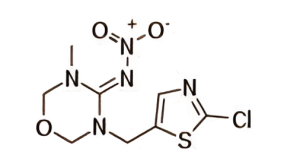
Common name: Thiamethoxam
Chemical name:
3-(2-Chloro-1,3-thiazol-5-yl)methyl-5-methyl-N-nitro-1,3,5-oxadiazinan-4-imine
Chemical calls: Insecticide
Molecular formula: C₆H₁₀C,N₂O₃S
CAS NO.: 153719-23-4
Properties:
White solid. M.p. 200-201°C; (tech., 195.5-203°C). V.p.
3.7×10⁻⁴ mPa (25°C). S.g./density: 1.477-1.626 (20°C). In water 1.9 (pH 5), 2.4 (pH 9), 1.9 (distilled) (all in mg/L, 20°C). In acetone 545.9, dichloromethane 22.3, hexane 0.028, toluene 3.0 (all in g/L, 20°C).
Mode of action:
Thiamethoxam is a systemic insecticide that is absorbed quickly by plants and transported to all parts of the plant, where it acts as a deterrent to insect feeding. It is active in the stomach of the insects, and also through direct contact. The compound interferes with information transfer between nerve cells, making the insects become paralyzed.
Usage:
Thiamethoxam is effective against aphids, thrips, beetles, centipedes, millipedes, sawflies, leaf miners, stem borers and
Control of multiple species of thrips on a broad range of crops by foliar, soil or seed treatment. Control of corn rootworm, wireworms and termites by soil treatment in maize. Control of boil weevil and plant bugs on cotton, diamond-back moth on crucifers, Colorado potato beetle on potatoes by foliar application. Control of stem borers, leaf miners, planthoppers, leaf folders/rollers and weevils in rice. Foliar application rates range from 10-80 g/ha; soil treatment rates 100-200 g/ha.
Normal Formulations:
97% Tech, 75% DF, 35% FS, 25% WDG/WP, 10% WDG