

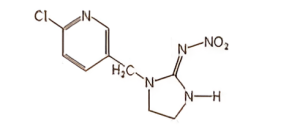
Common name: Imidacloprid
Chemical name: 1-(6-chloro-3-pyridylmethyl)-N-nitroimidazolidin-2-ylideneamine
Chemical class: Insecticide
Molecular formula: C₉H₁₀ClN₅O₂
CAS NO.: 138261-41-3
Properties:
Colourless crystals, with a weak characteristic odour.
M.p. 144°C. V.p. 4×10⁻⁷ mPa (20°C); 9×10⁻⁷ mPa (25°C).
S.g./density 1.54 (23°C). In water 0.61 g/L (20°C). In dichloromethane 67, isopropanol 2.3, toluene 0.69 (all in g/L, 20°C); in n-hexane <0.1 g/L (ambient temperature).
Mode of action:
Systemic insecticide with transaminar activity and with contact and stomach action. Readily taken up by the plant and further distributed acropetally, with good root-systemic action.
Usage:
Control of sucking insects, including rice-, leaf- and planthoppers, aphids, thrips and whitefly. Also effective against soil insects, termites and some species of biting insects, such as rice water weevil and Colorado beetle. Has no effect on nematodes and spider mites. Used as a seed dressing, as soil treatment and as foliar treatment in different crops, e.g., rice, cotton, cereals, maize, sugar beet, potatoes, vegetables, citrus fruit, pome fruit and stone fruit. Applied at 25-100 g/ha for foliar application, and 50-175 g/100 kg seed for most seed treatments, and 350-700 g/100 kg cotton seed. Also used to controls fleas in dogs and cats.
Normal Formulations:
95% Tech, 70% WG/WP, 50% FS, 35% SC, 20% SL,
10% WP, 6% WS